Journeal preview showing guided journaling cards and a dark journal entry screen

Journeal

Building a journaling app that accompanies you during your therapy journey.

Type of project: UX Project
Process: From scratch

Reading time: 10 minutes

Problem statement

Many people undergoing therapy struggle to stay consistent with prescribed exercises due to busy schedules or forgetfulness. Those unfamiliar with journaling often find it hard to capture insights gained during and between sessions. Additionally, tracking progress throughout the therapy journey can be difficult, and maintaining journaling, insight gathering, and exercise routines after therapy ends is often a challenge.

How can a journaling app help patients stay consistent with therapy exercises and keep track of the insights gained from therapy sessions?

Introduction

User story

Leo, 30 years old, started therapy after experiencing episodes of anxiety. Throughout his journey, he realizes he lacks a dedicated space to record insights gained in therapy sessions, or simply the thoughts that arises between sessions. He never kept a diary, so he ends up storing his reflections in disorganized notes on his phone. He also struggles to stay consistent with the exercises prescribed by his therapist because he often forgets or cannot find time in his schedule.
How can we help him?

Target users

The app's target users are teenagers and adults aged 15 to 35 who have started therapy and struggle to organize their thoughts and stay consistent with prescribed exercises.


Primary research

Objectives

What does an ideal journaling experience look like for users, and which features are essential?

What difficulties do users face when keeping a journal?

What challenges do they encounter in staying consistent with therapy exercises?

How do users hold themselves accountable after their therapy ends, and if they don't, what barriers prevent them from doing so?

Set up

  • Participants: 20 individuals who are currently undergoing therapy or have completed a therapy journey. 9 of them also keep (or kept) a journal.
  • Type of research: questionnaire.

Insights

Since the app is a journaling tool, the questionnaire was designed to gather insights into both the participants' journaling experiences (if any) and their therapy journeys.

The theme of "lack of time" emerged repeatedly in participants' responses, cited both as a reason for inconsistency in journaling and as a barrier to keeping a journal altogether.

Eight out of nine respondents reported using paper and pen or pencil for their journaling experiences, rather than digital tools.

Regardless of whether they currently keep a journal, the majority of respondents expressed interest in trying a journaling app in the future. Among those who said they would not use a digital journaling app, three main reasons emerged:

  • The screen feels distracting.
  • They prefer to continue using paper and pen.
  • Paper and pen create a sense that the session is "just for themselves," turning journaling into a personal ritual that offers a meaningful, private moment.

Journaling practices vary among users. While free writing - writing a stream of thoughts, experiences, and insights before or during the session - is the most common method, other practices are also used by participants or have caught their interest.

Only a few respondents write down insights gained from therapy. Interestingly, some participants who do not record these insights still consider the practice important.

The main reasons for not completing therapy exercises are lack of time, motivation, and forgetfulness.

Suggestions

Scheduled reminders: notify users to complete exercise, record insights or journal at chosen times (e.g., morning or night).

Timed sessions: allow setting short timers (e.g., 5-10 minutes) for time-based exercises and journaling sessions.

Distraction-free writing: block notifications temporarily.

Guided journaling sessions: help overcome blank-page syndrome with prompts and structure.

Multimodal expression: support text, voice, photos and videos.

Gamification: use badges and streaks to motivate habit formation.

Easy experience: minimize friction for seamless use.

Offer multiple journaling methods.

Strategy and branding

Personas

Illustration of a person who struggles with consistency

Strugglers: individuals who struggle to stay consistent (with exercises or journaling) due to lack of time and motivation.

Illustration of a person new to journaling

Newbies: individuals who have never journaled, often due to lack of time, motivation, or uncertainty about what to write or where to start.

Illustration of a person who doesn't record therapy insights

Non-recorders: individuals who have never written down their therapy insights but still consider them important.

Lean branding

Values

We are
  • Empathetic
  • Simple
  • Inspiring
We are not
  • Disorganized
  • Inefficient
  • Shortsighted

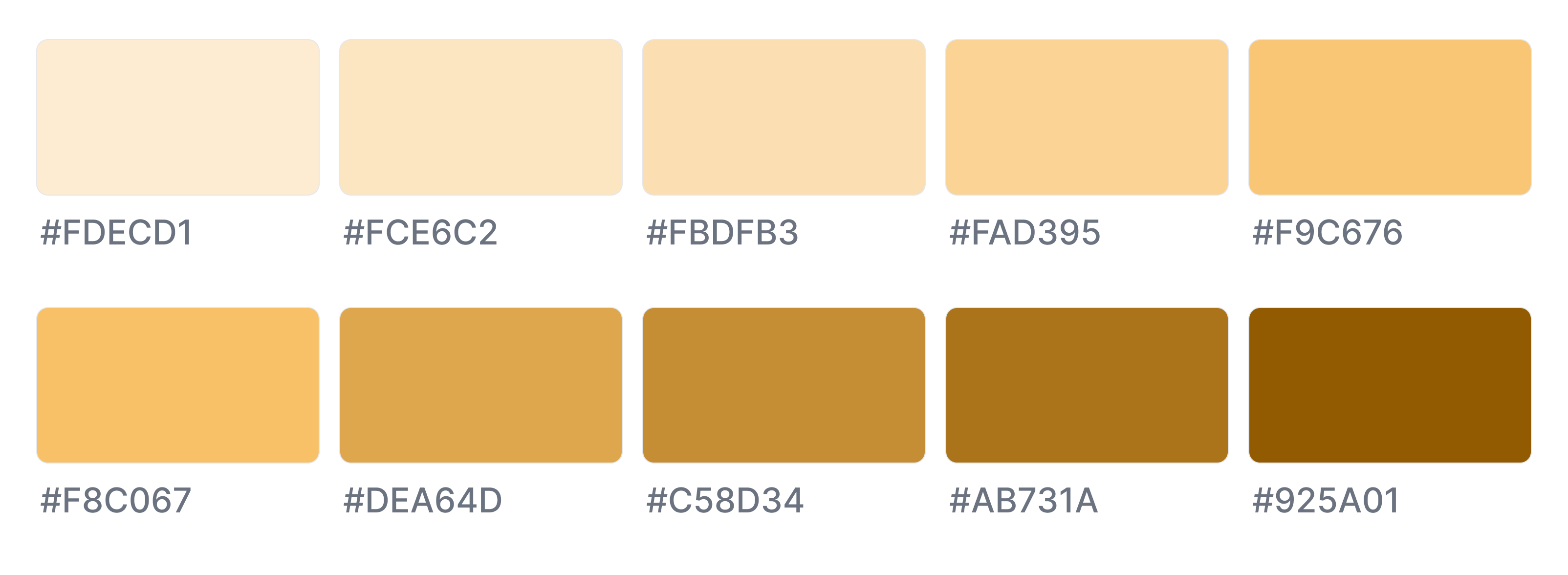
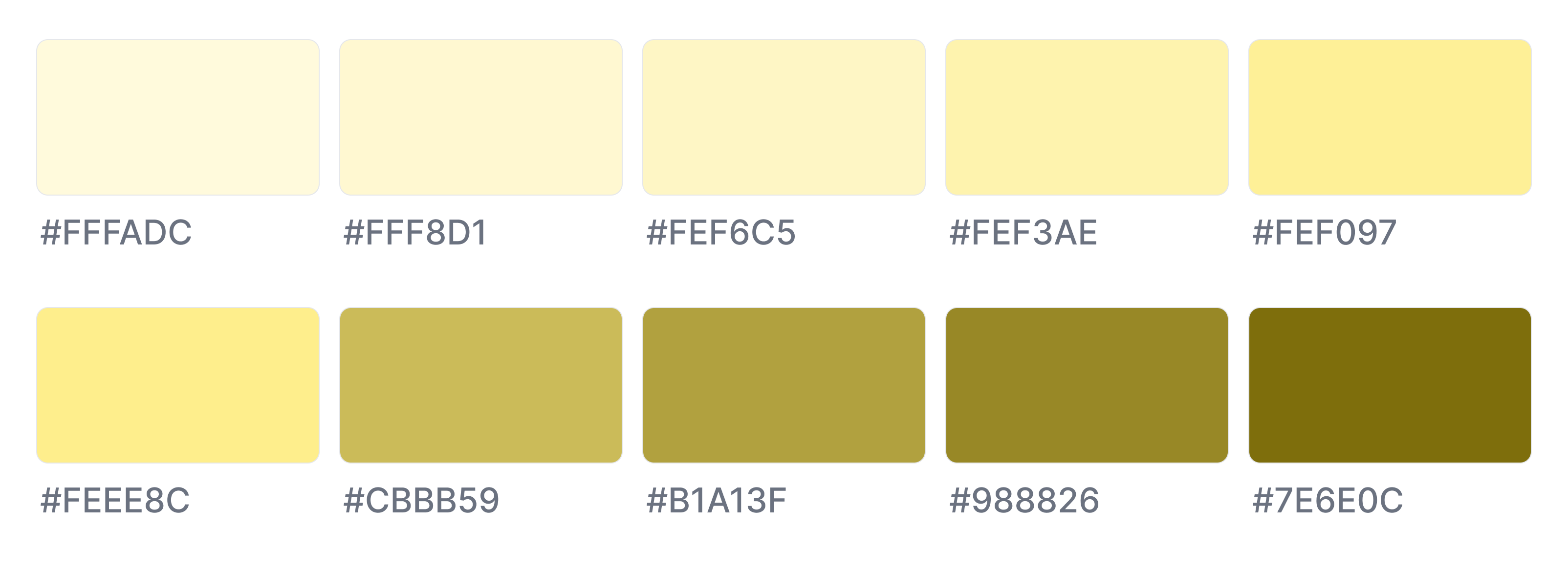
Primary colors palettes

Journeal app primary color palette Journeal app secondary color palette

Design and prototypes

Sitemap

Designs

The finished app will have five sections:

  • Journaling: dedicated to journaling practices.
  • Therapy: dedicated to the registration of therapy insights and assigned exercises.
  • Mood: for mood tracking.
  • Habit: for habit tracking (keeping track of the good habits one wants to incorporate into their everyday life).
  • Podcast: for the listening of weekly podcasts about psychology. It is also possible to visualize the content of the podcast i written form.

This overview highlights and describes only the first two sections, which are the main focus.

Journaling section

In this section users can view their past entries and create new ones. They can create different type of entries, and here we cover four of them.

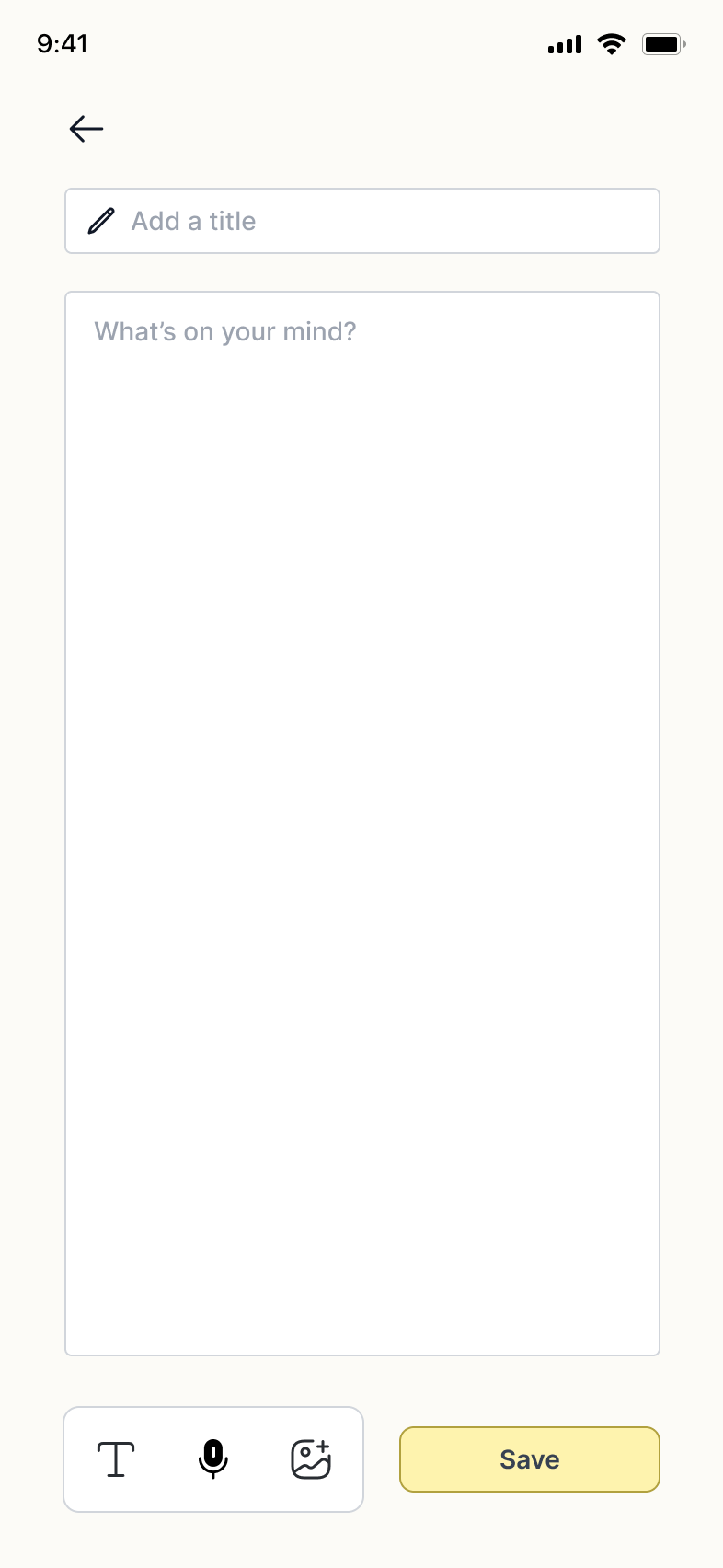
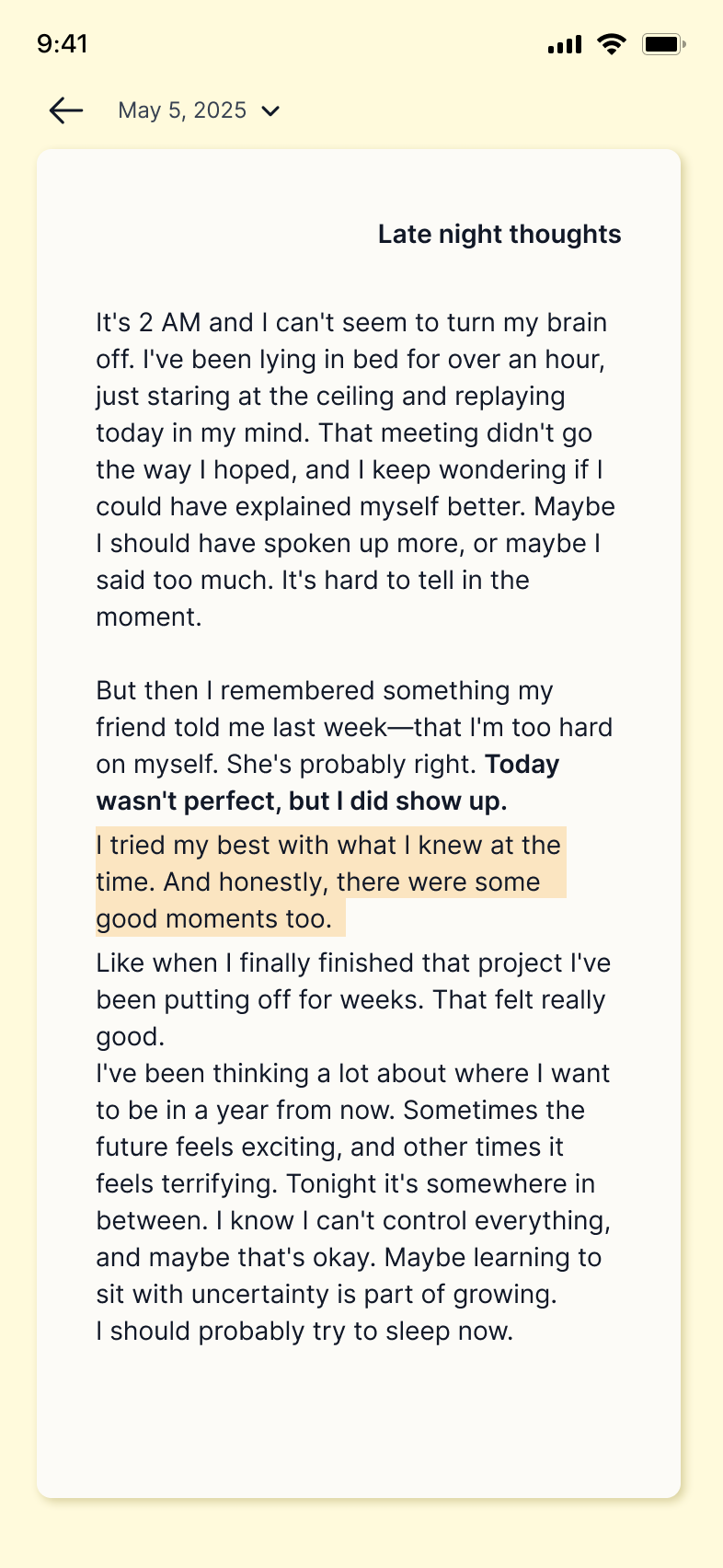
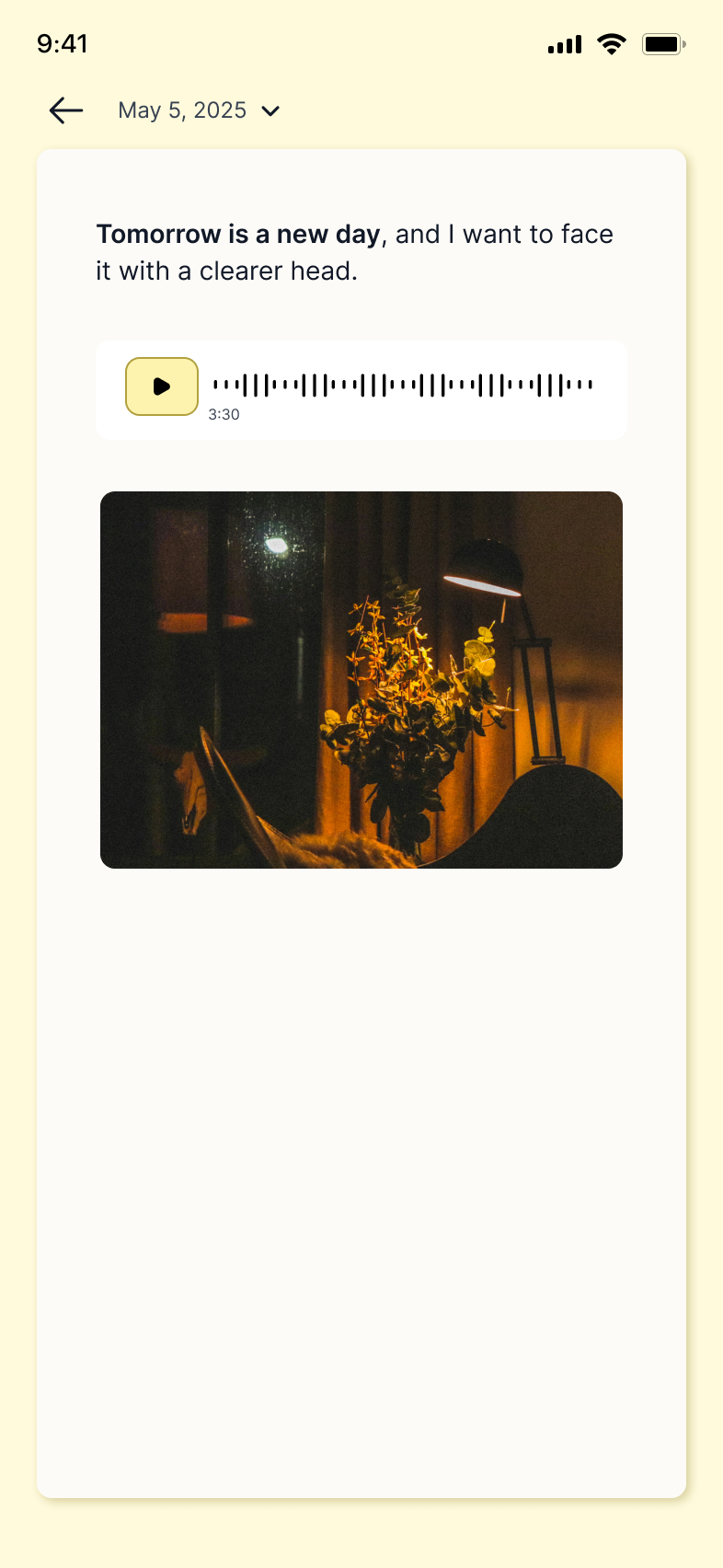
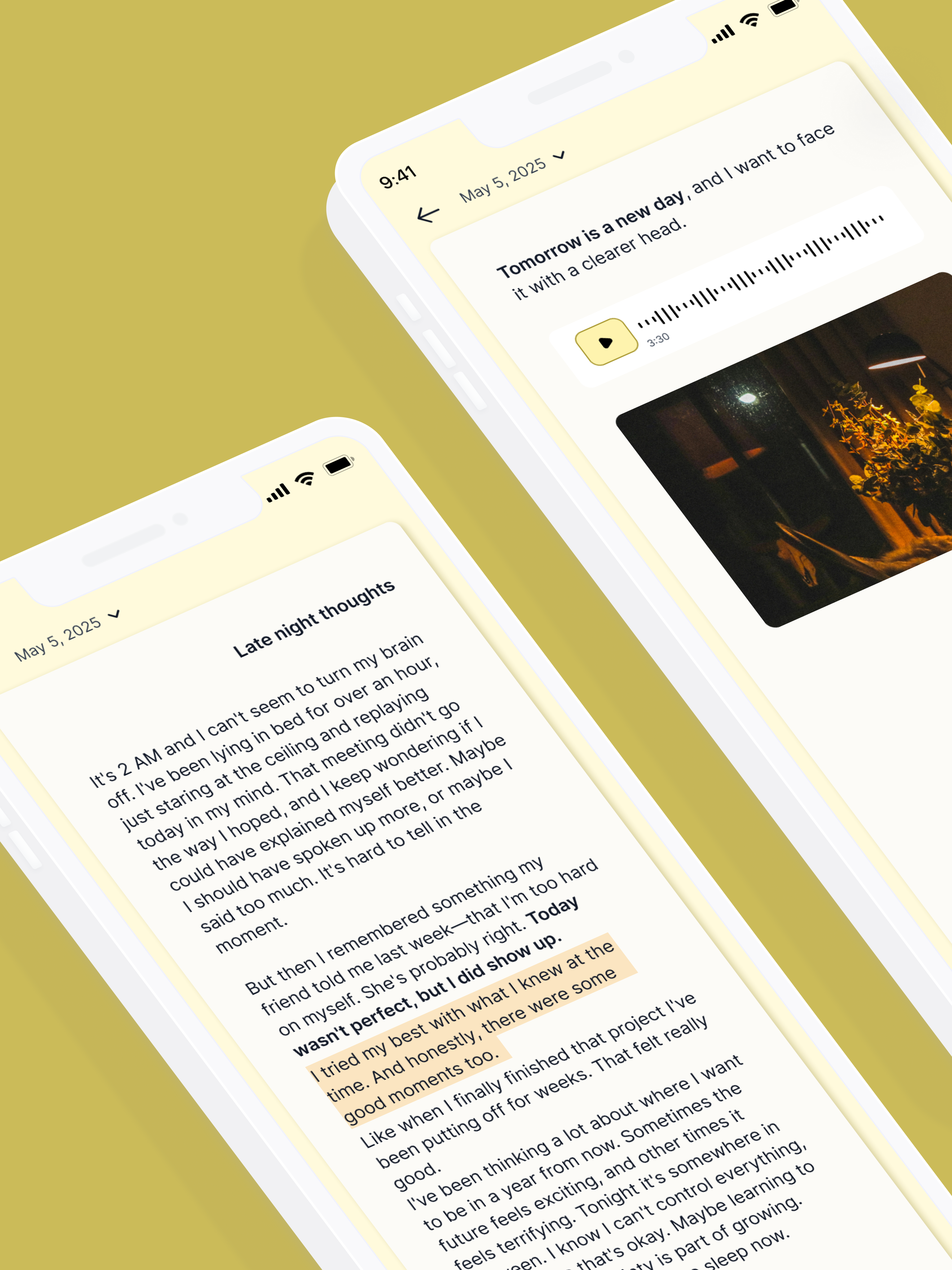
Blank page: exactly like a blank page in a diary, this function allow the user to write freely. The user can also upload audios, images and videos to accompany their text.

Blank page input screen Blank page visualization Blank page with media

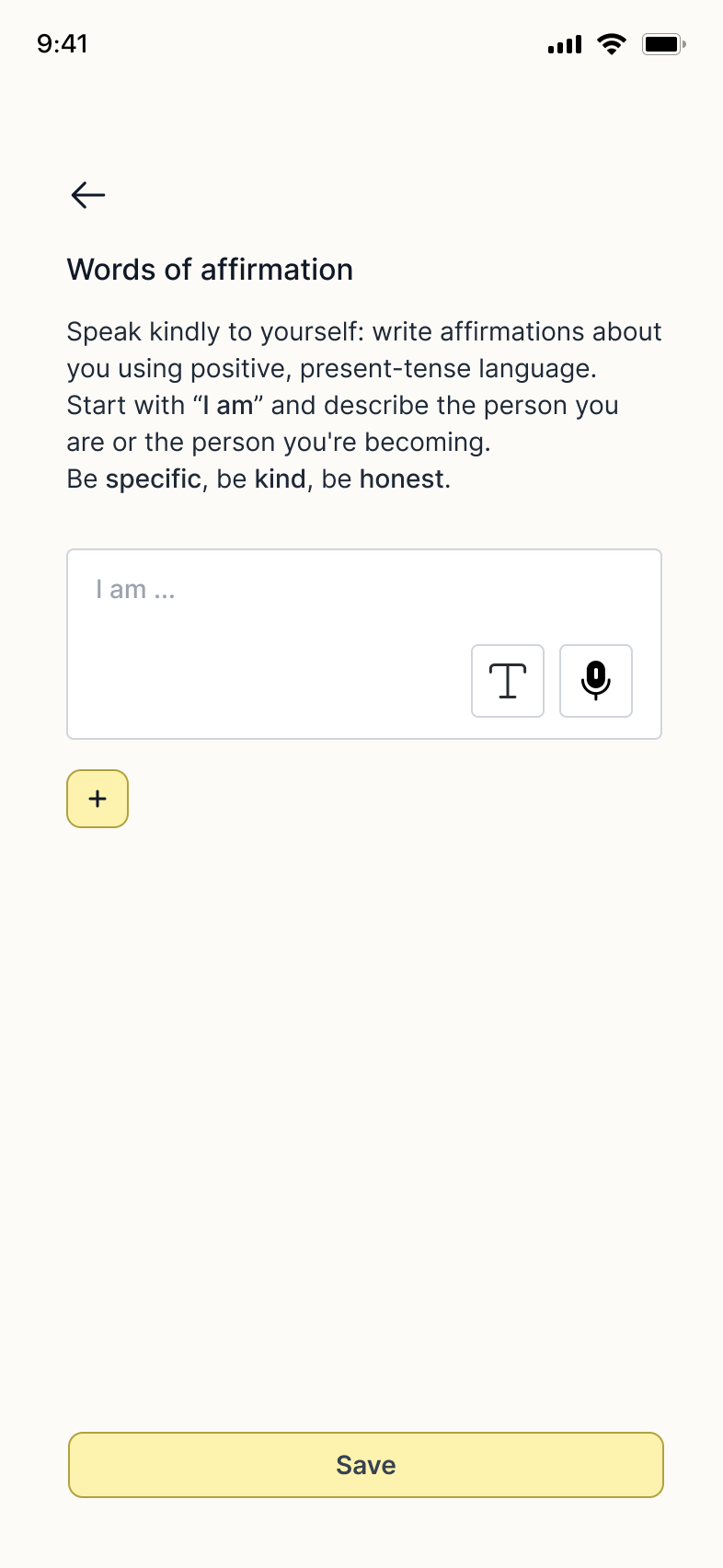
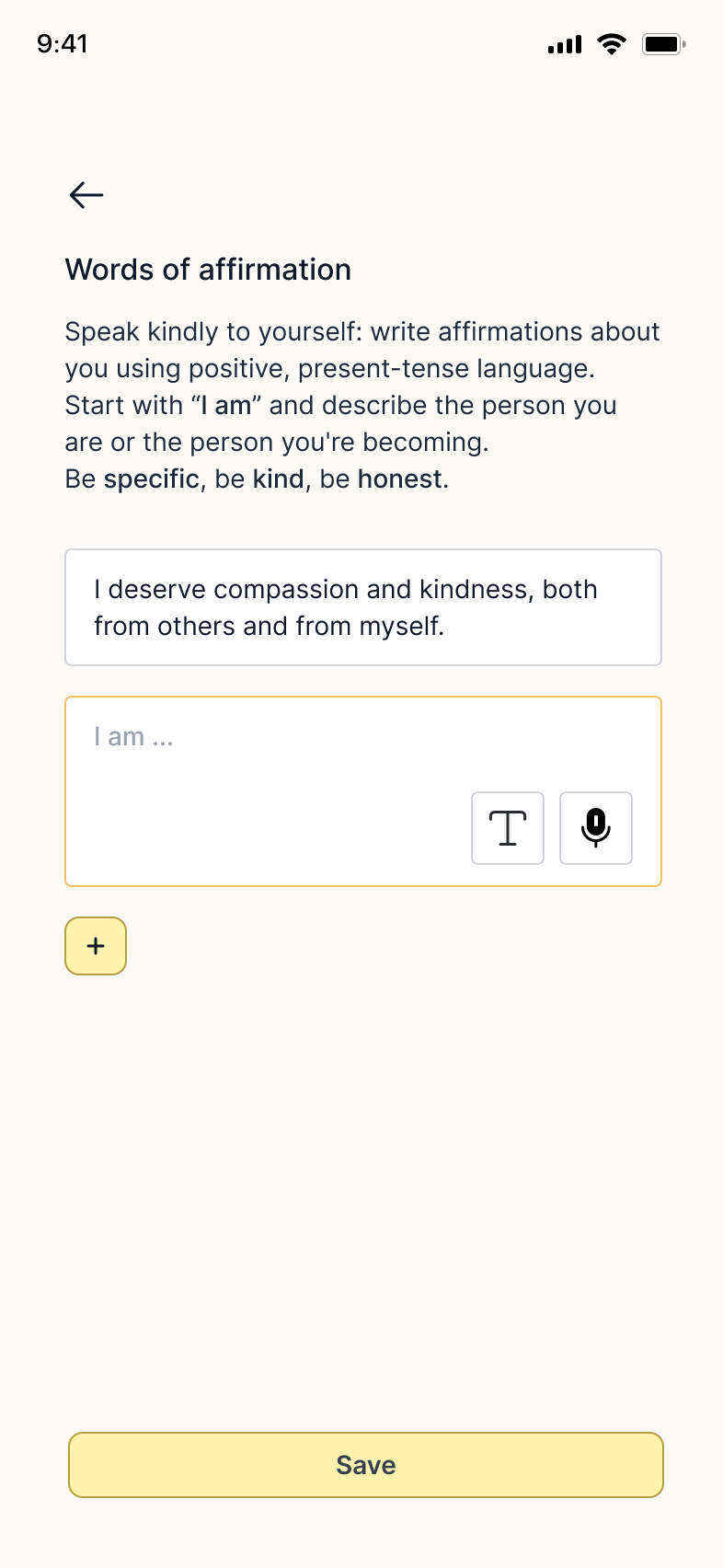
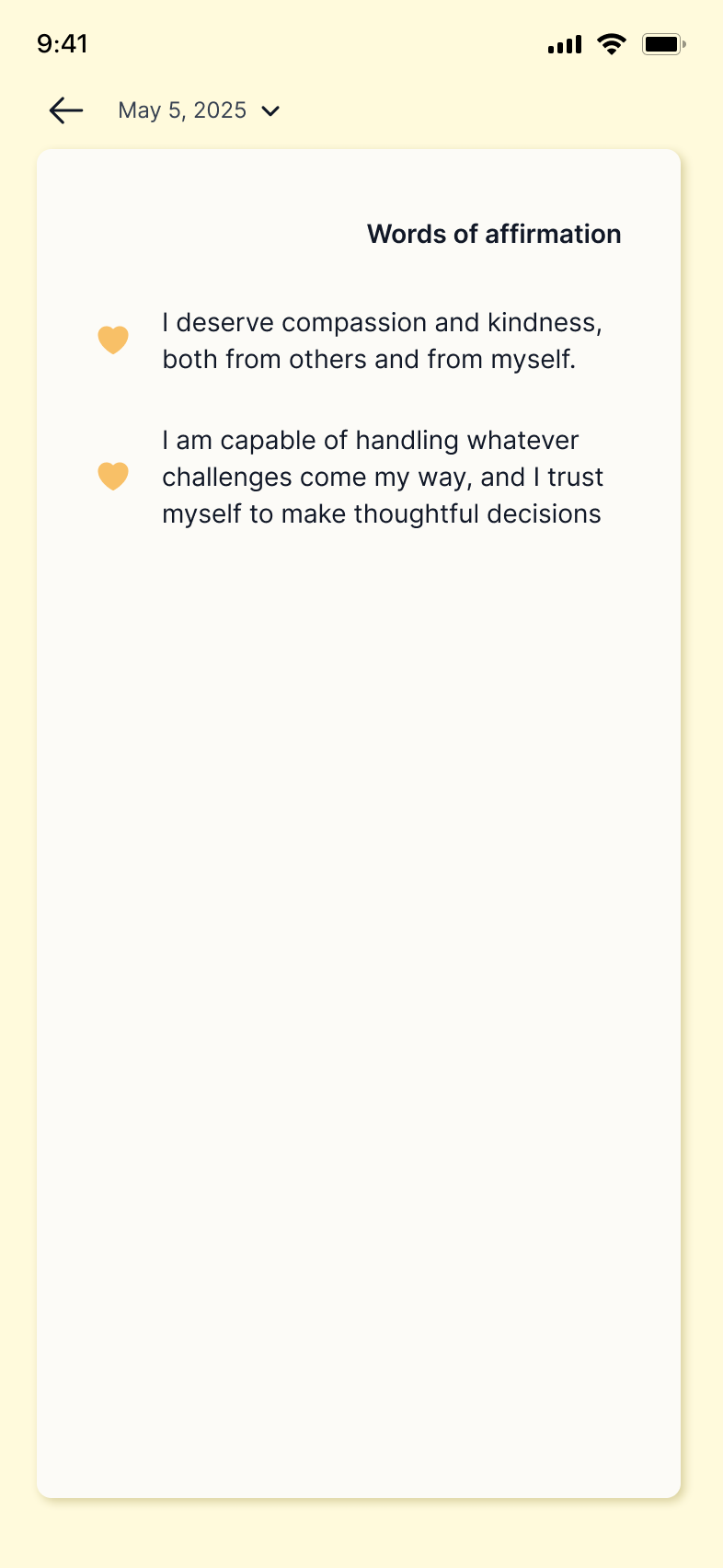
Words of affirmation: writing positive, uplifting statement about themselves to promote self-love, confidence and a positive mindset.

Words of affirmation input screen Words of affirmation input continued Words of affirmation visualization

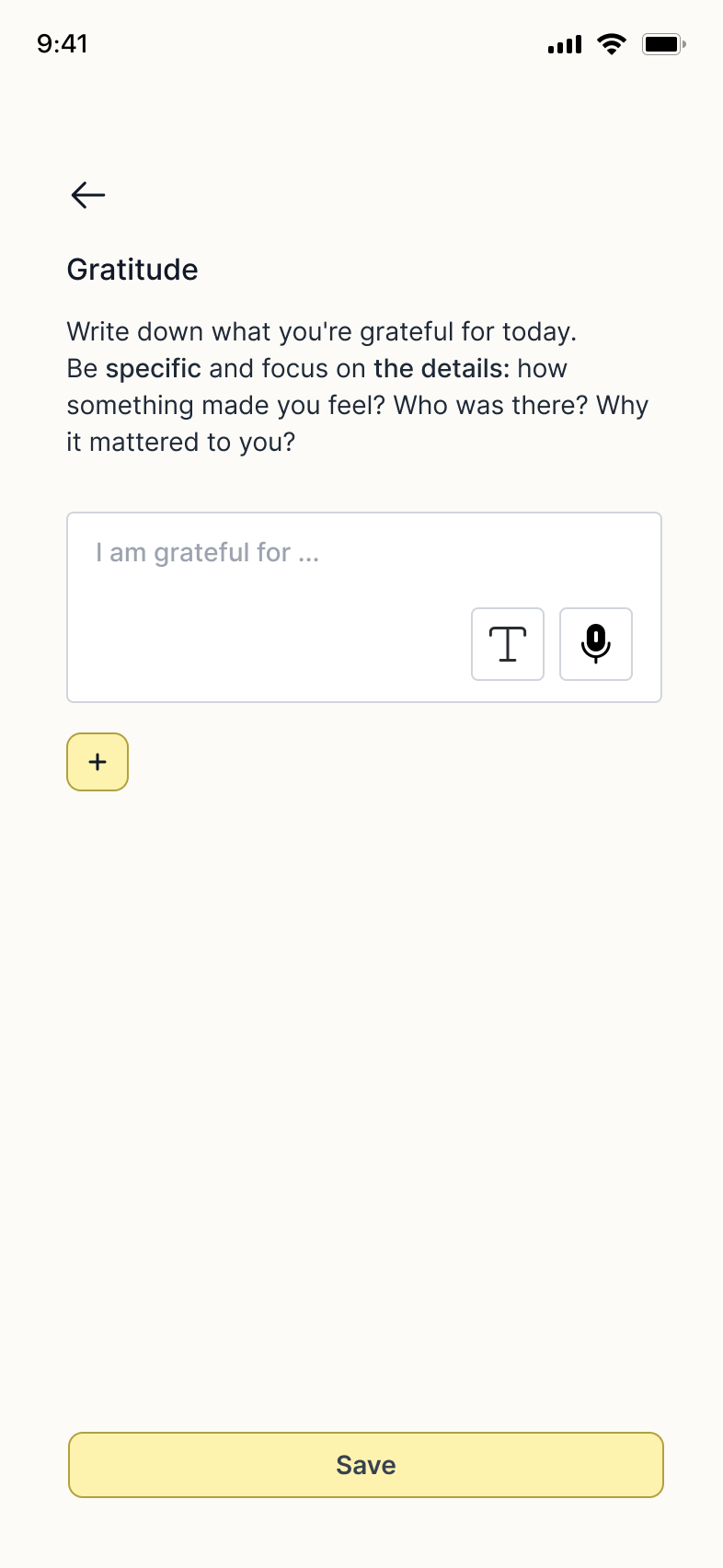
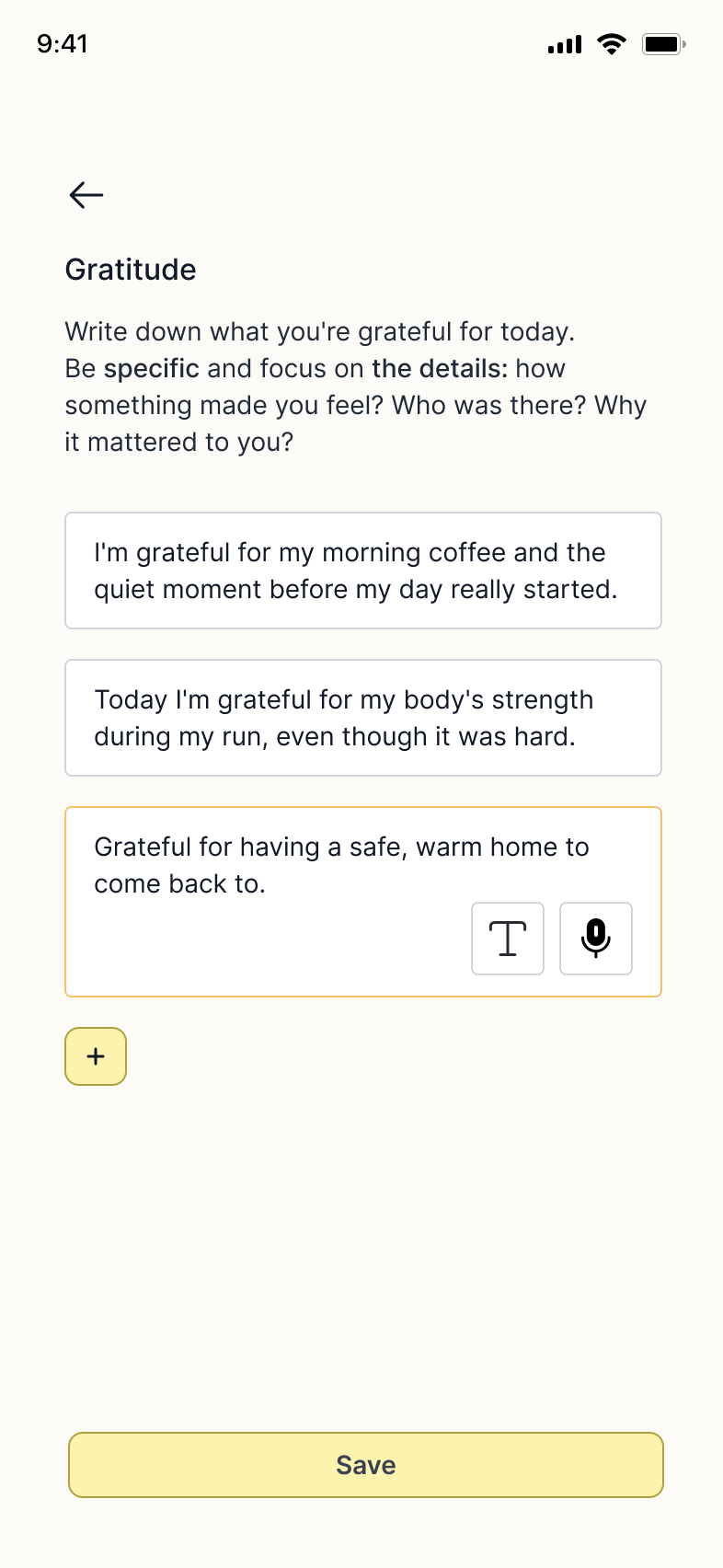
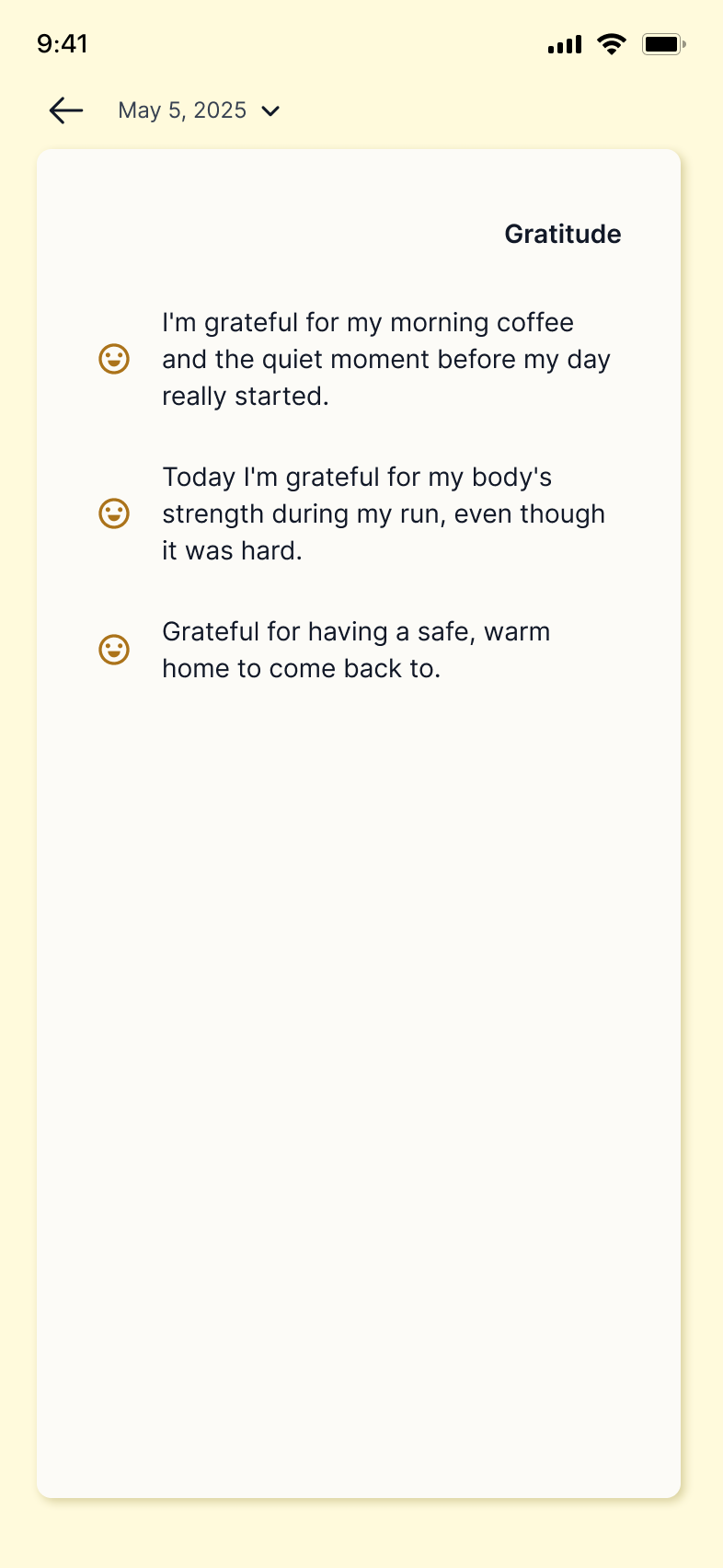
Gratitude: writing down the things one is grateful for.

Gratitude input screen Gratitude input continued Gratitude visualization

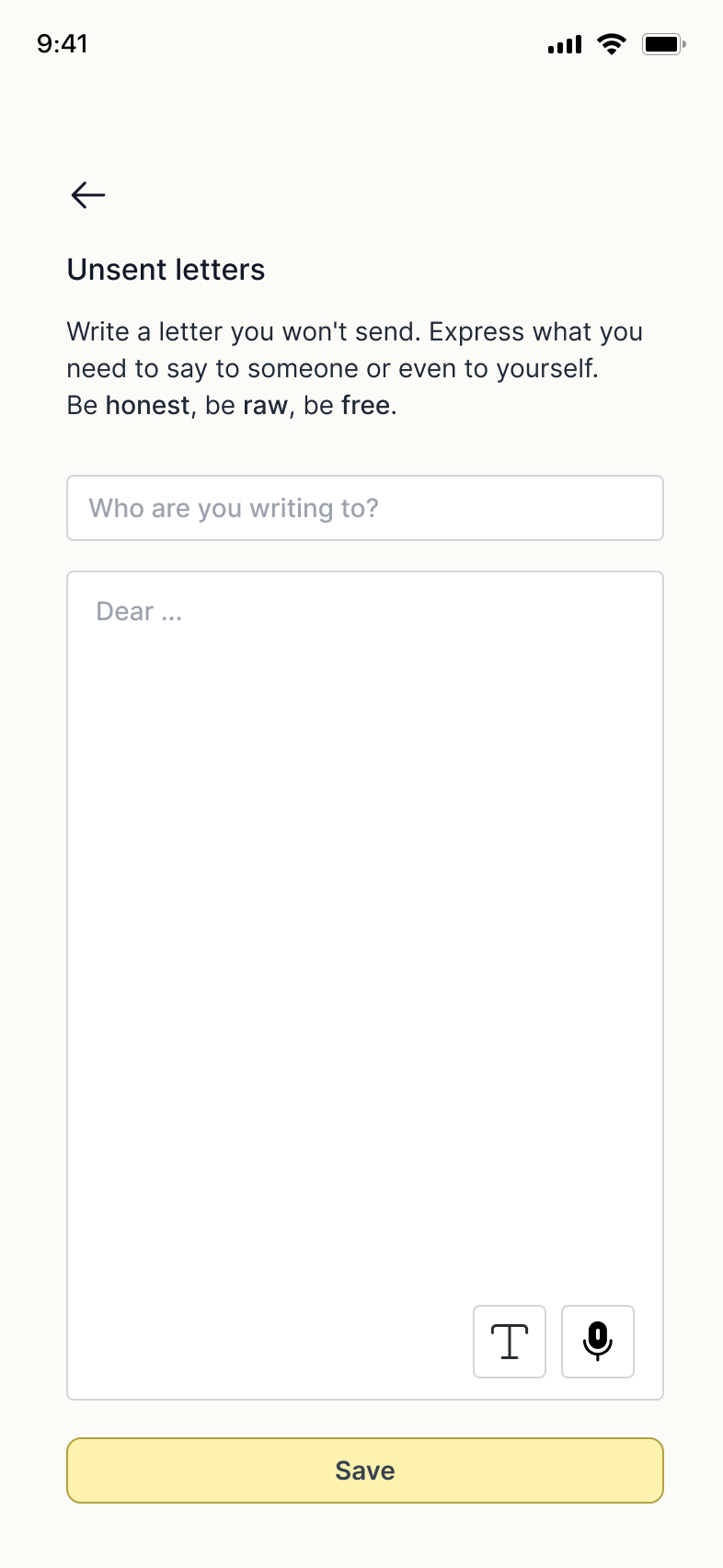
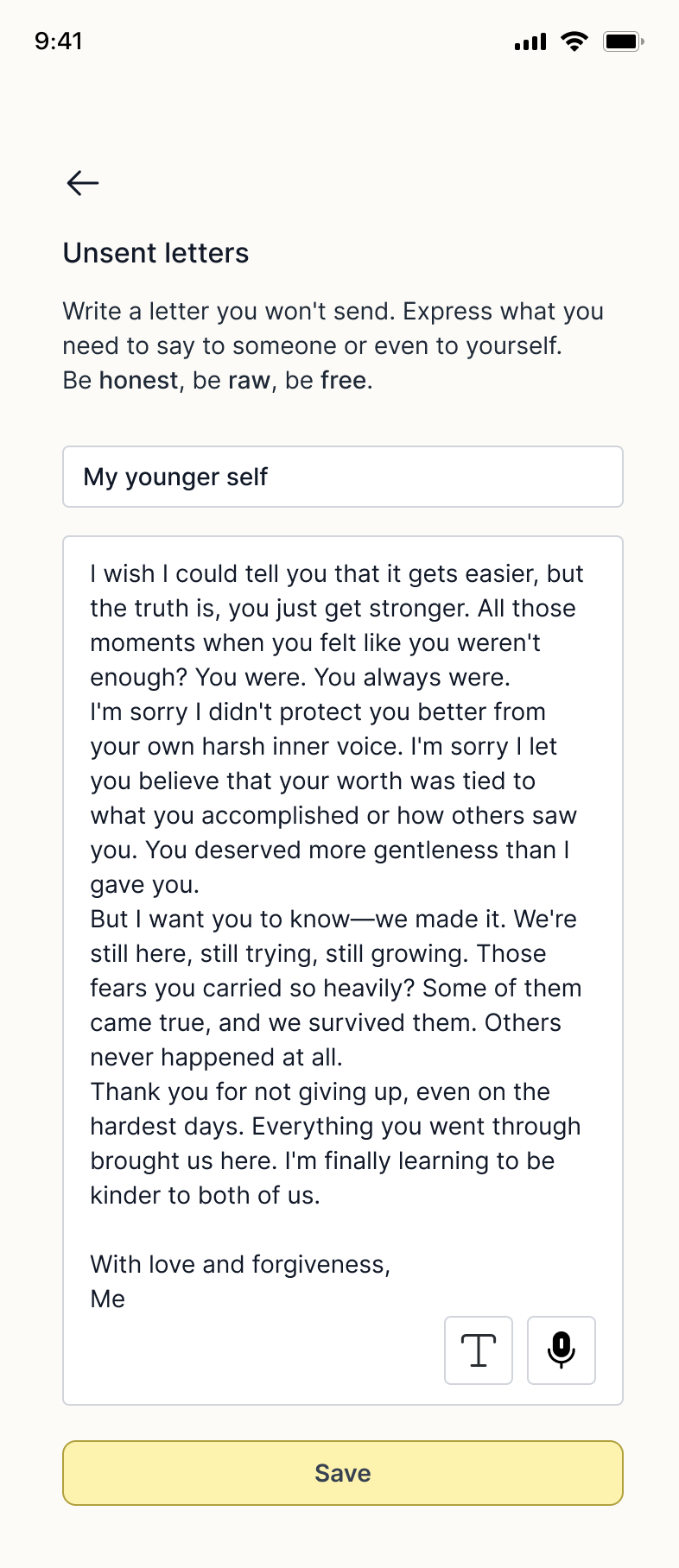
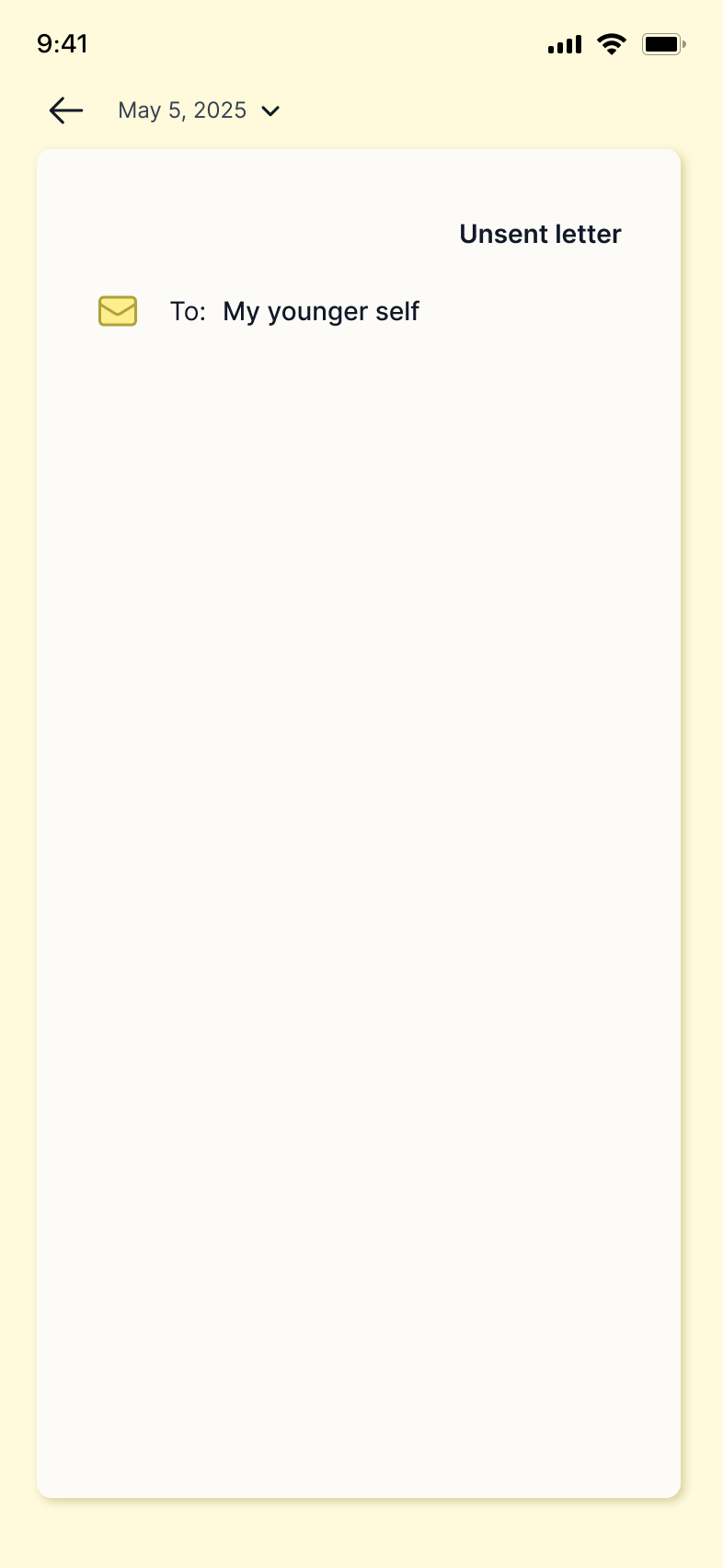
Unsent letters: write letters that are not meant to be sent, in order to process my emotions or achieve emotional closure.

Unsent letters input screen Unsent letters input continued Unsent letters visualization

Therapy section

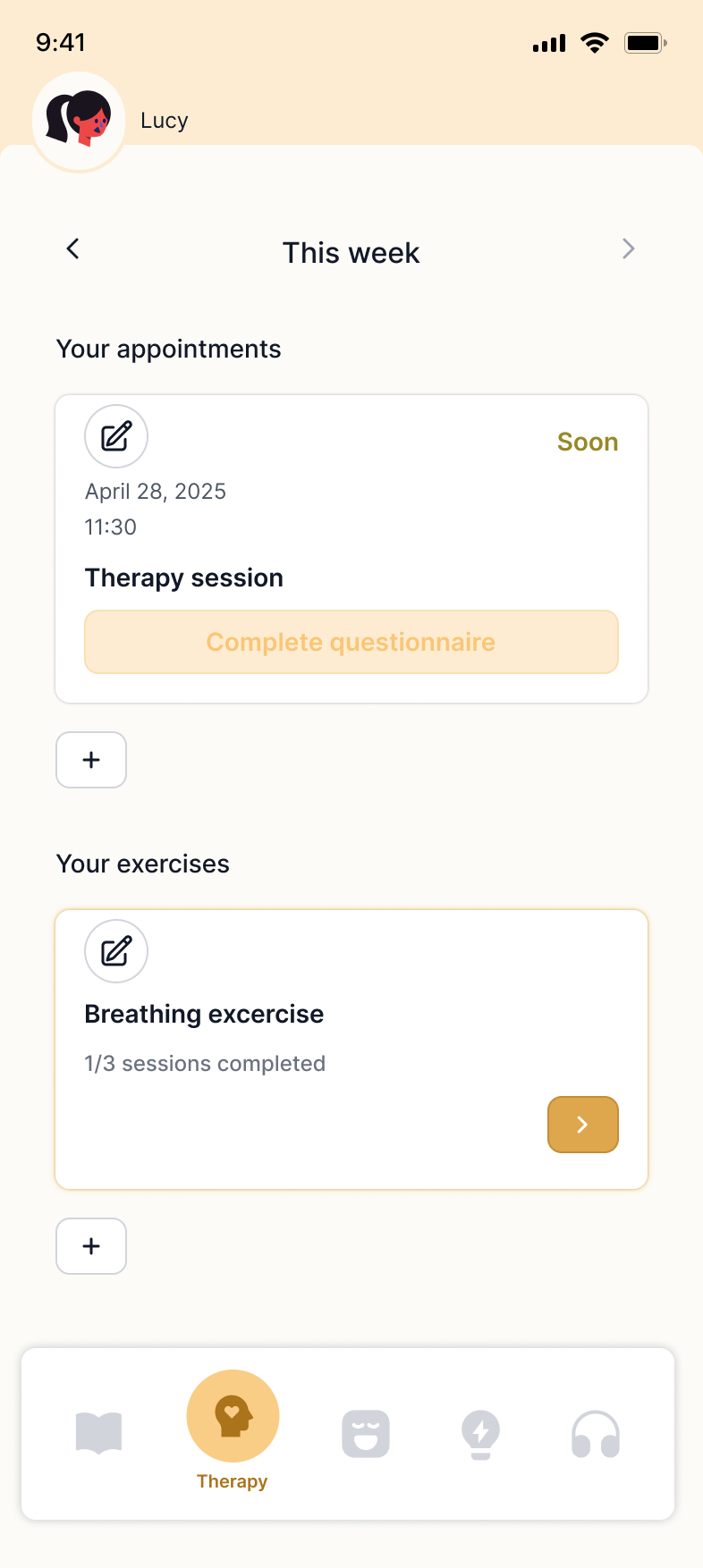
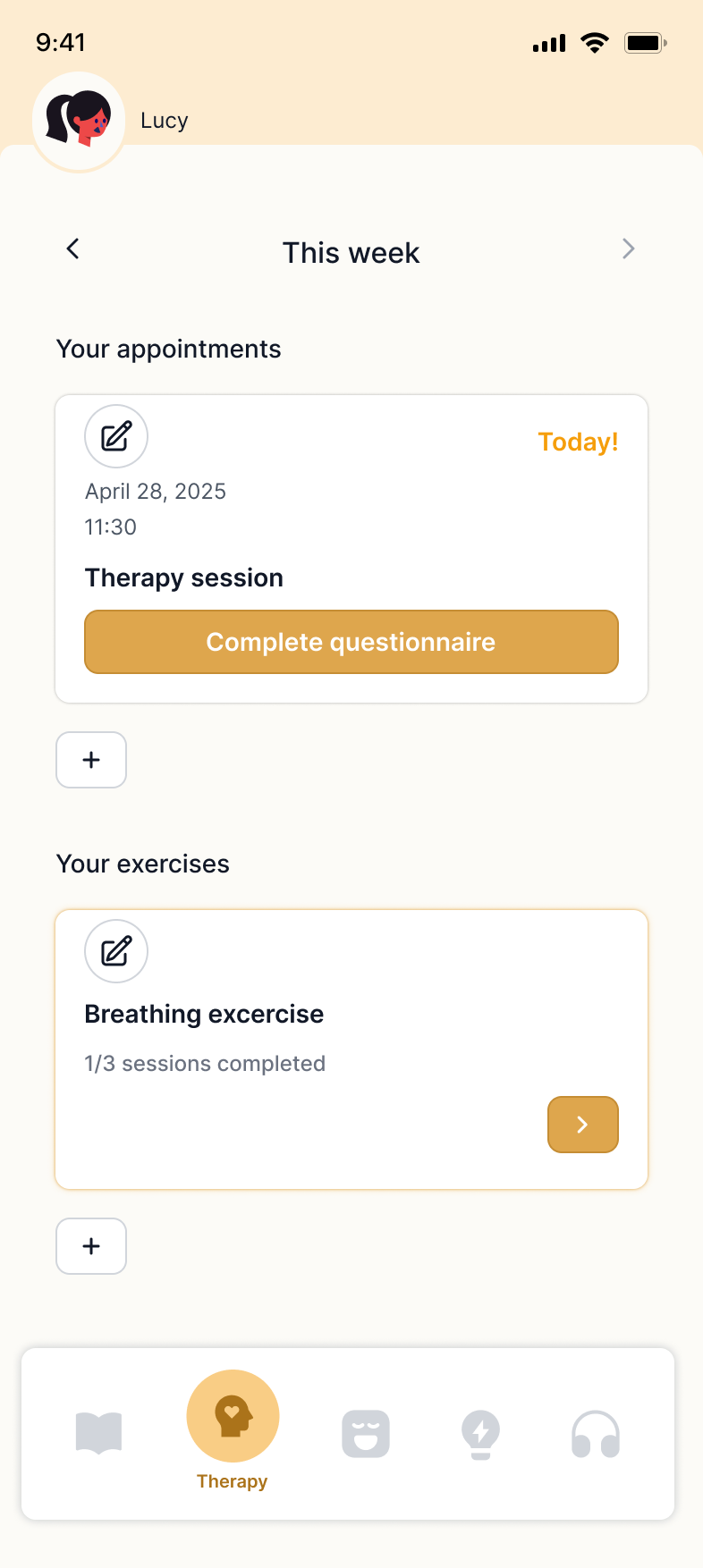
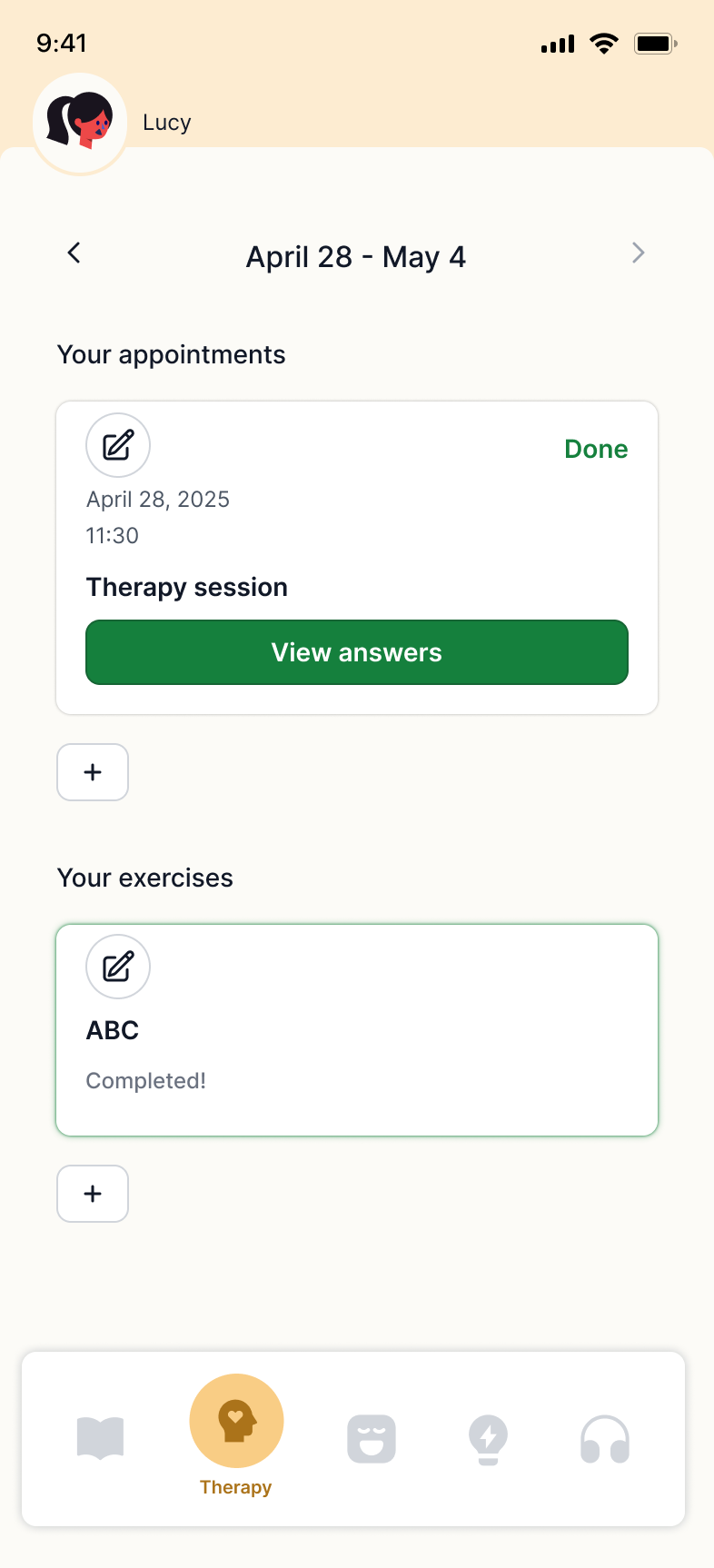
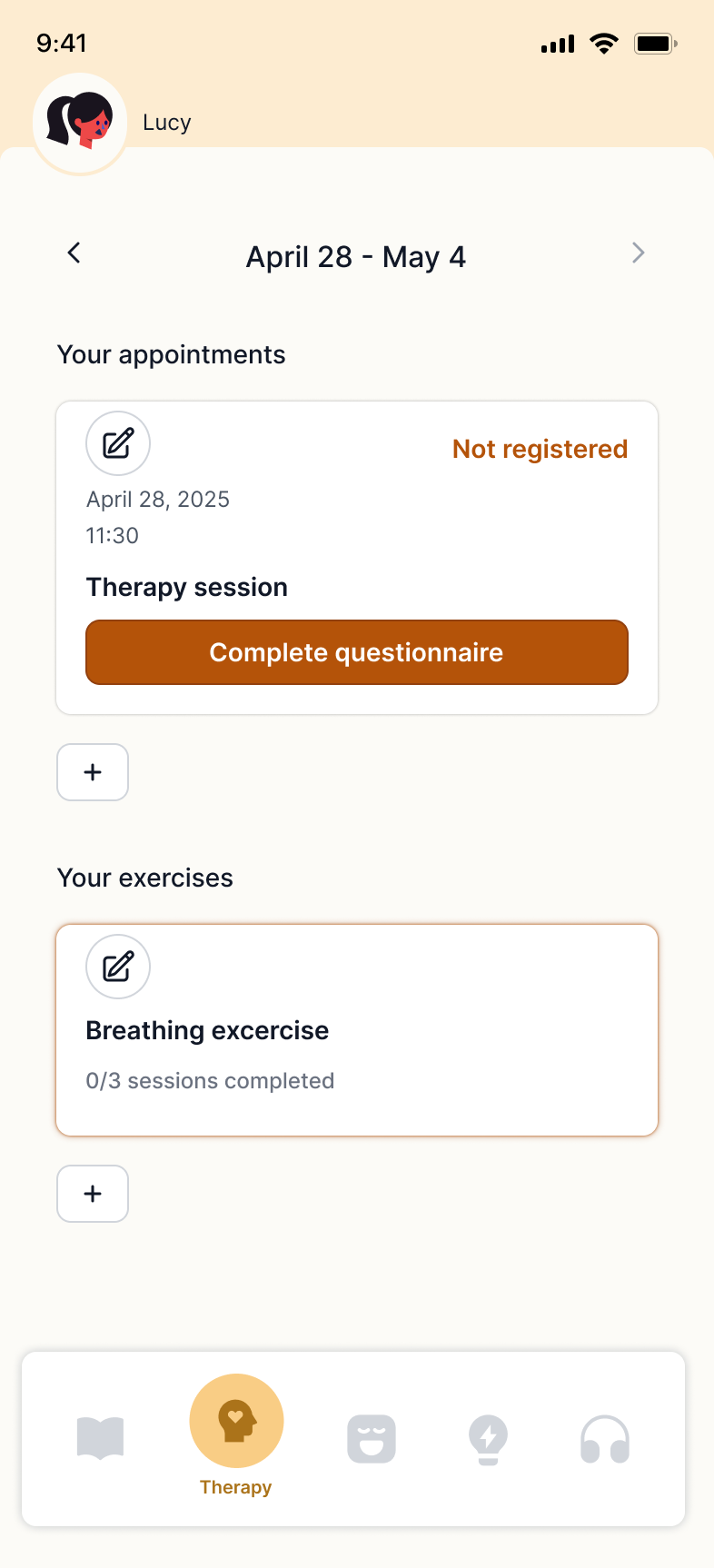
In this section, users can view their therapy sessions and assigned exercises for the week. Therapy sessions may be upcoming (scheduled later in the week), planned for the current day, or already completed. After each session, the app will send a notification prompting the user to complete a questionnaire. A button under the appointment details will indicate the questionnaire's status: blocked, available, completed, or not completed.

Therapy section showing upcoming session Therapy section showing today's session Therapy section showing completed session Therapy section showing unregistered session

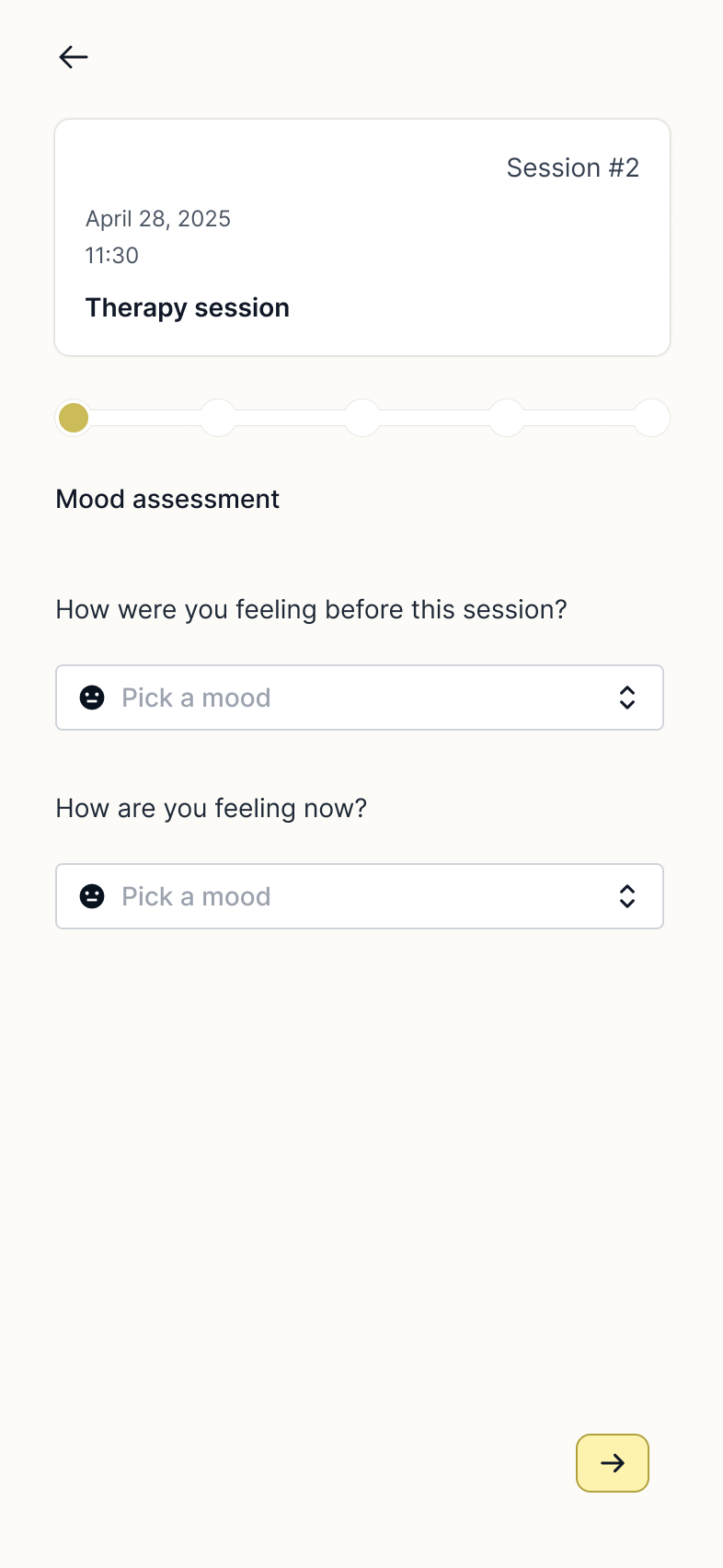
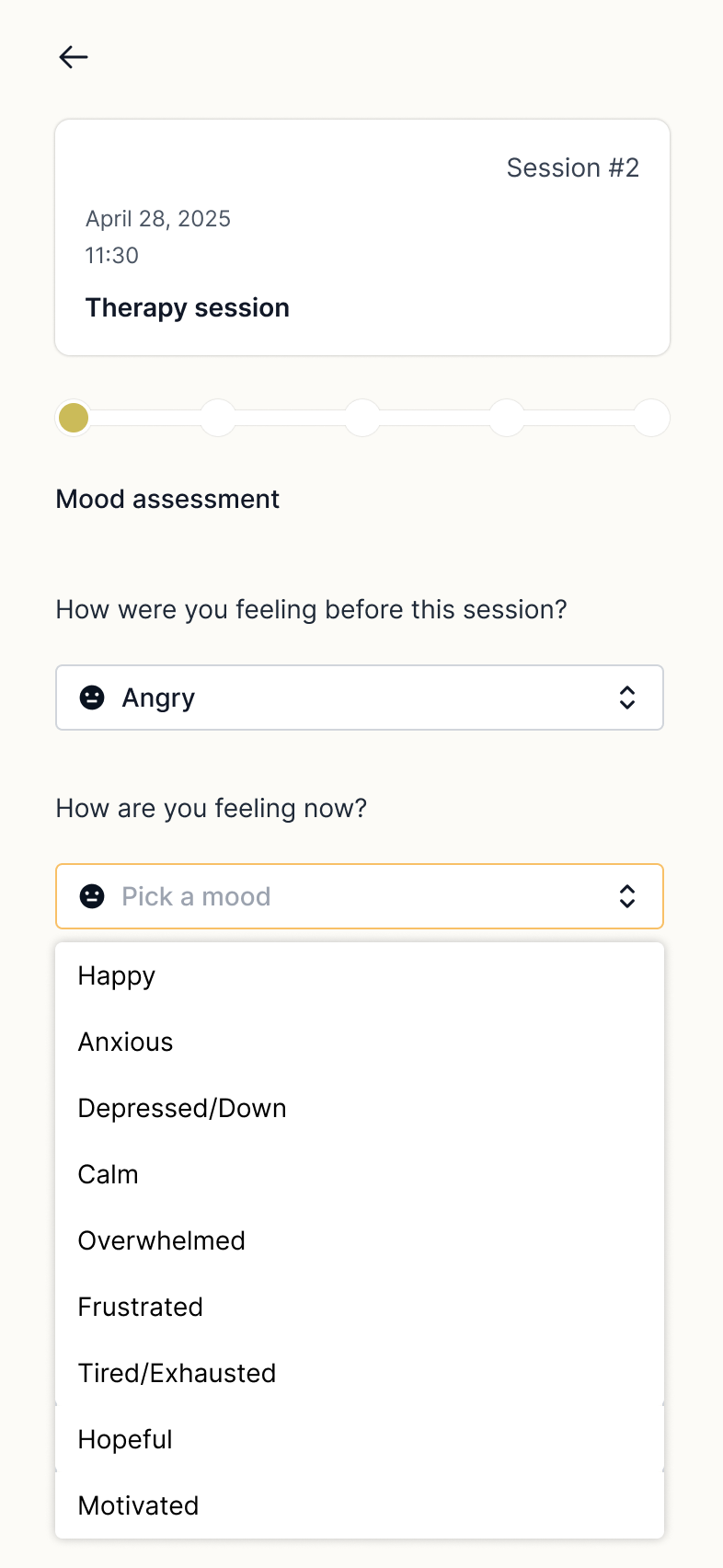
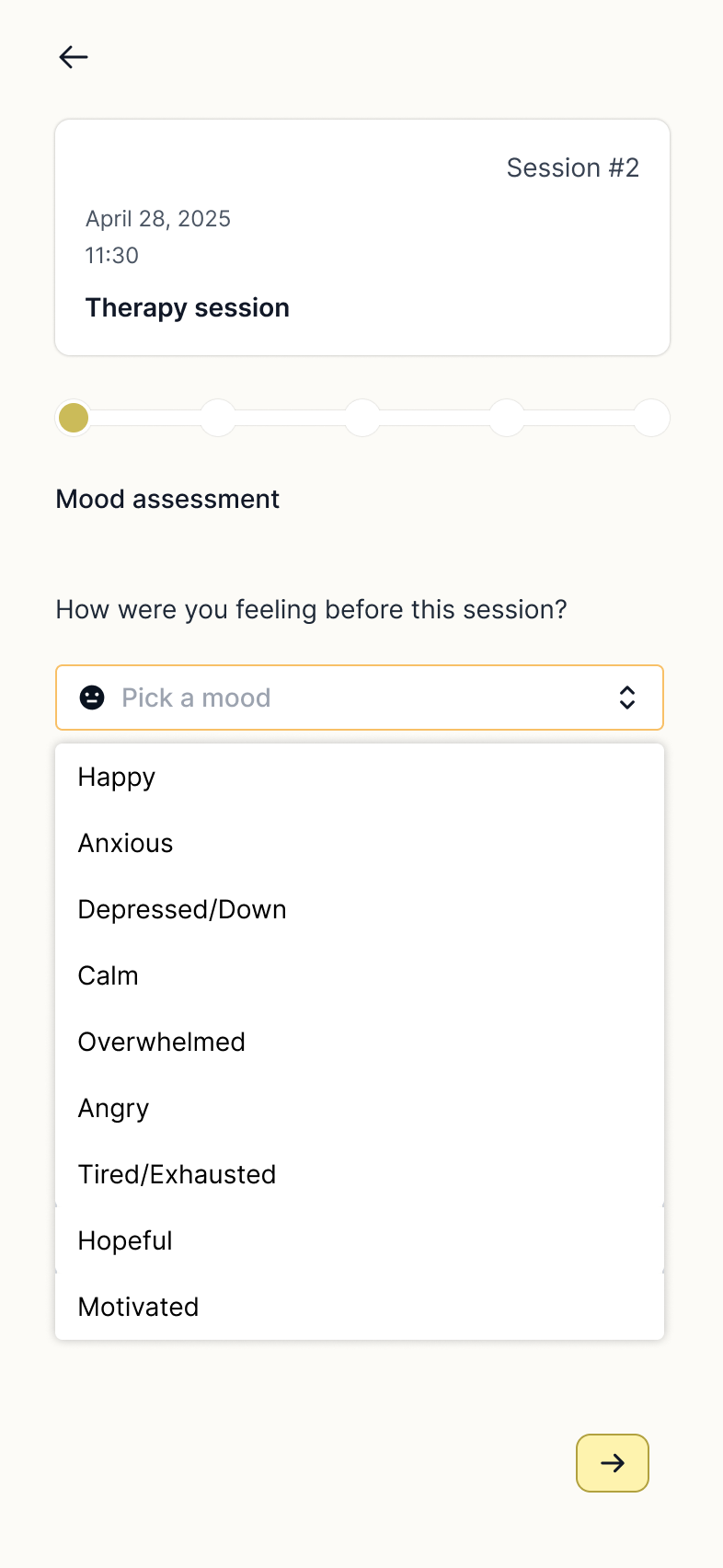
The questionnaire is composed structured in 5 parts. The first section collect information about the users' mood before and after the session.

Questionnaire mood before session Questionnaire mood selection Questionnaire mood after session

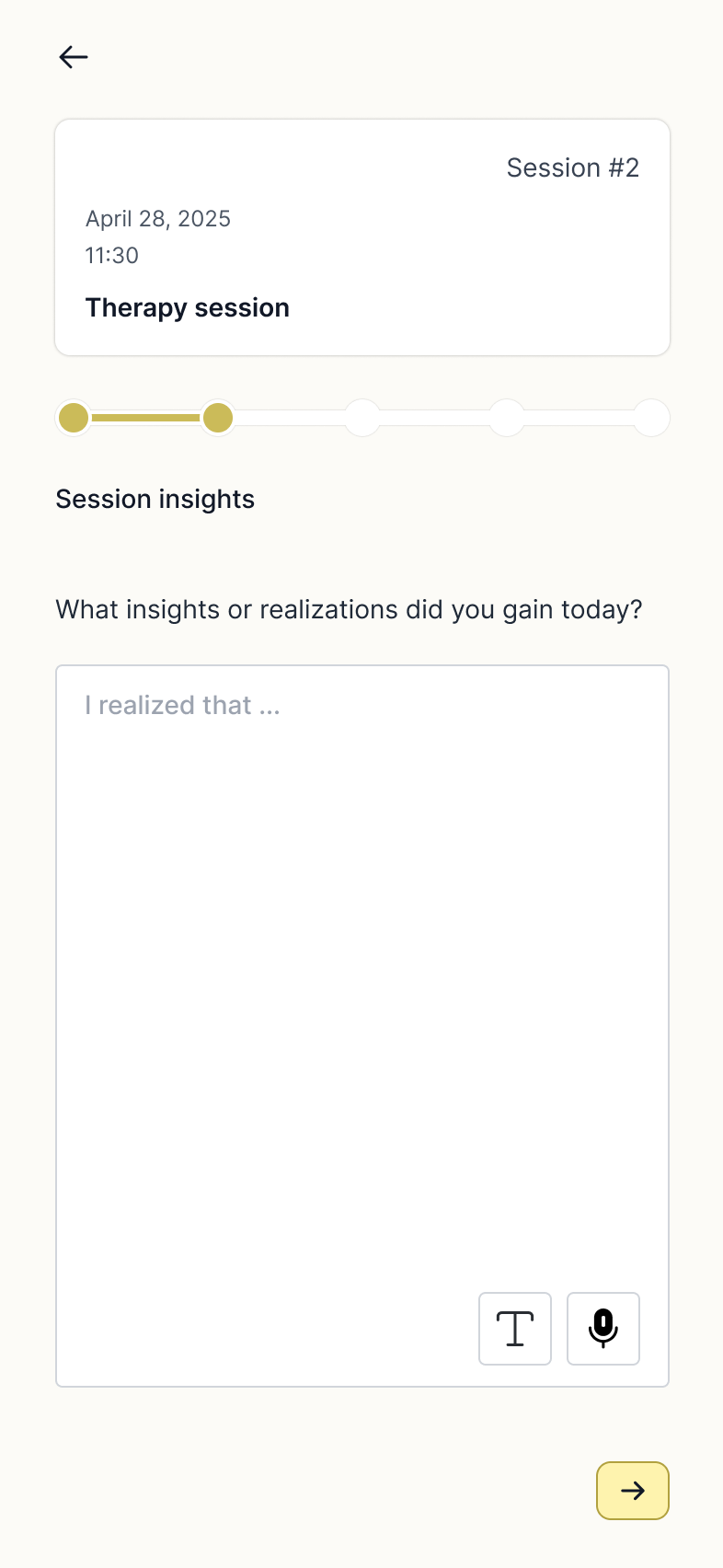
The second part aims to collect users' insights about the therapy session.

Questionnaire insights screen

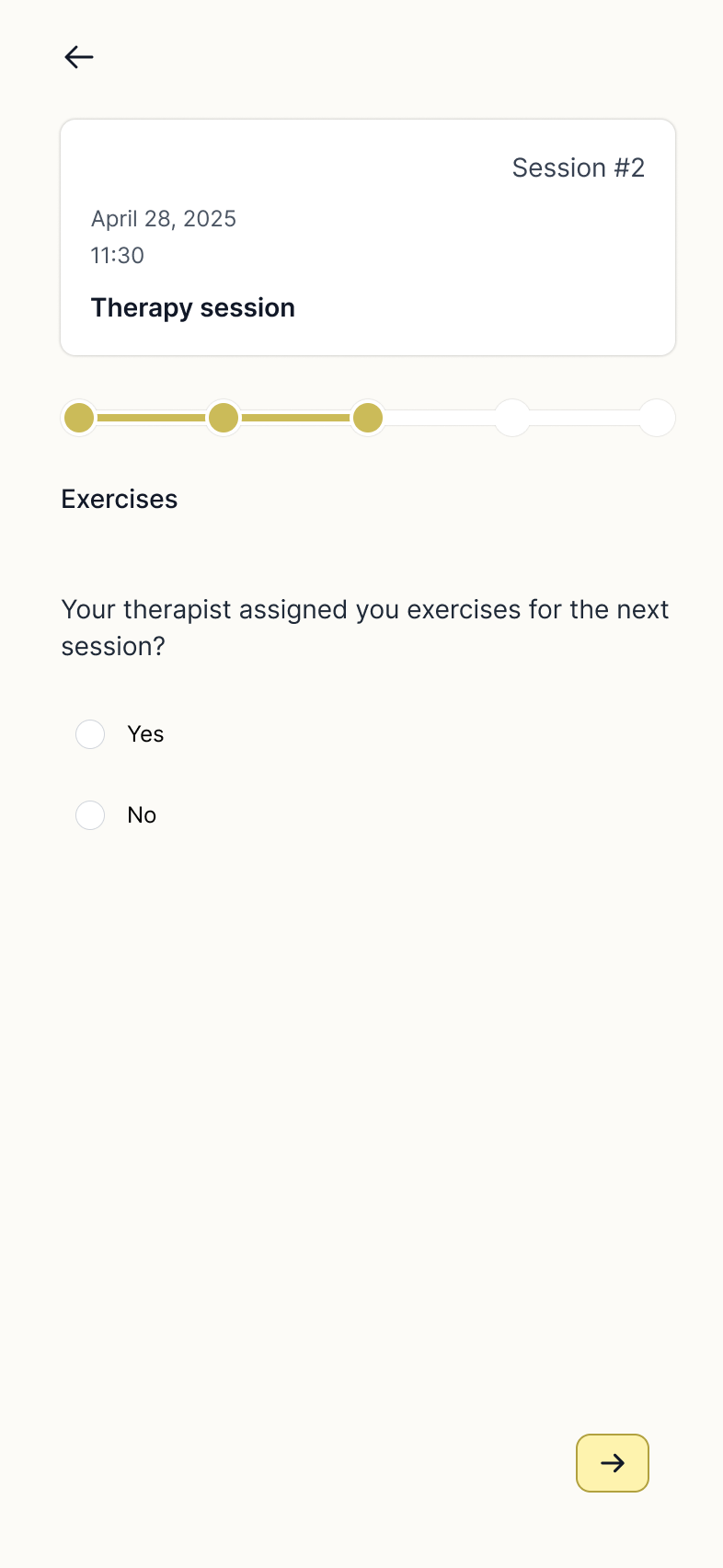
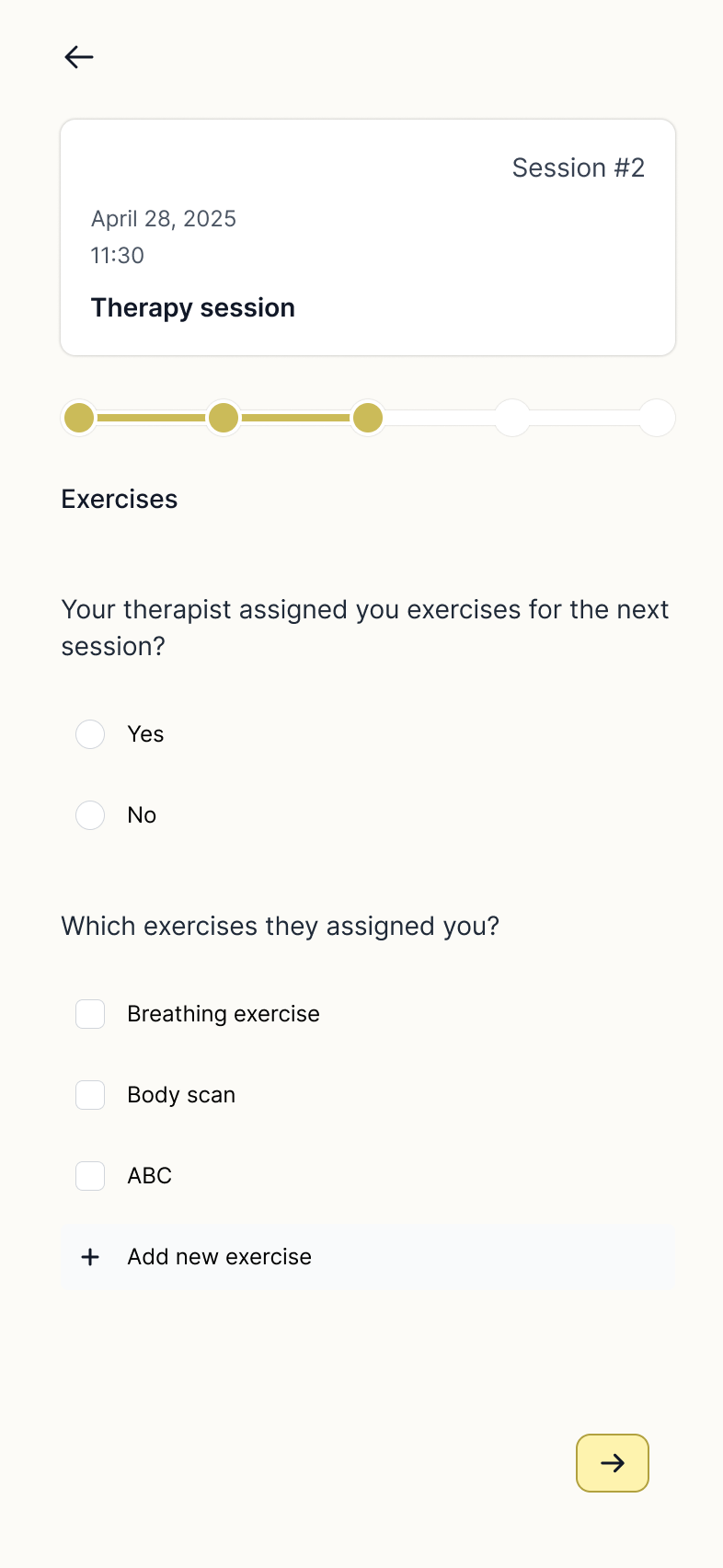
Then, the users can add information about the assigned exercises.
Questionnaire exercises input Questionnaire exercises continued

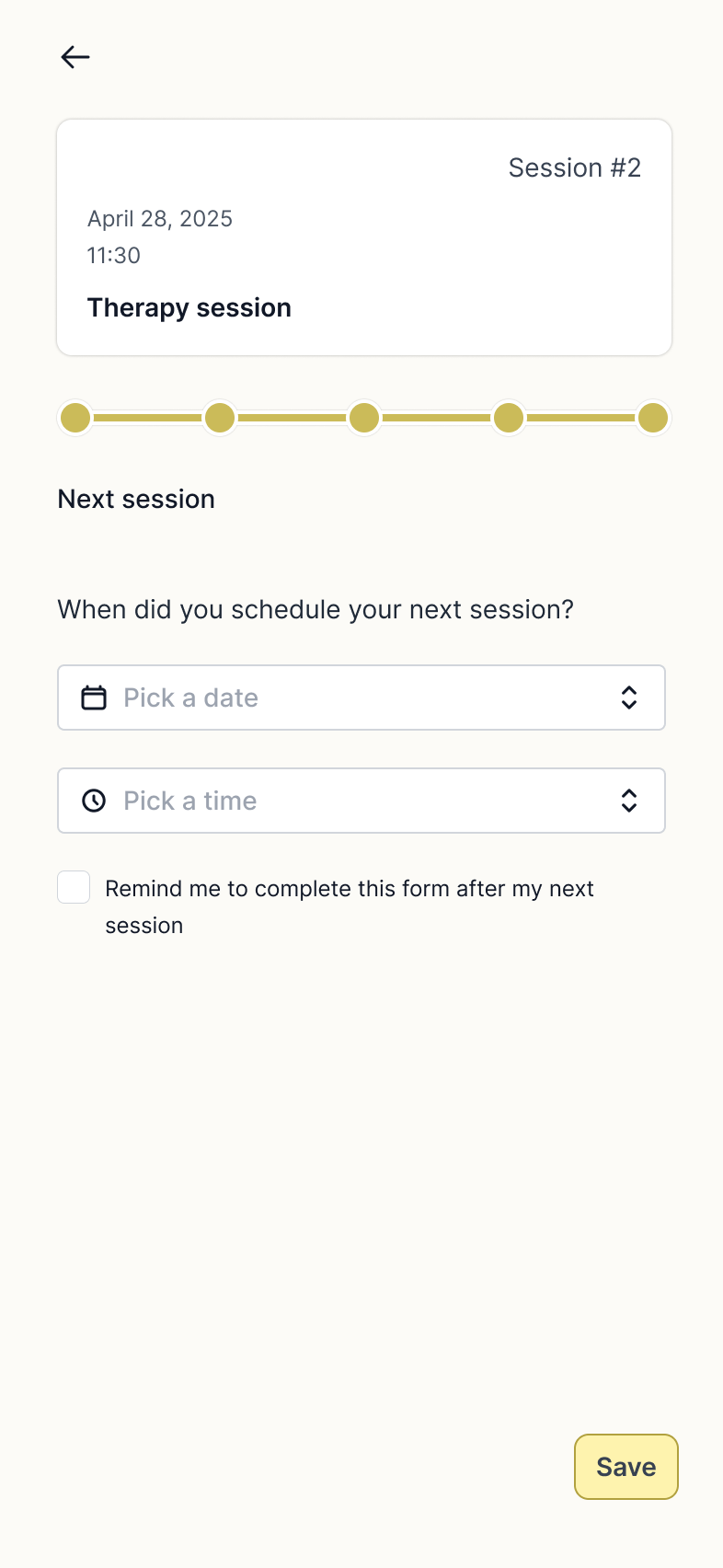
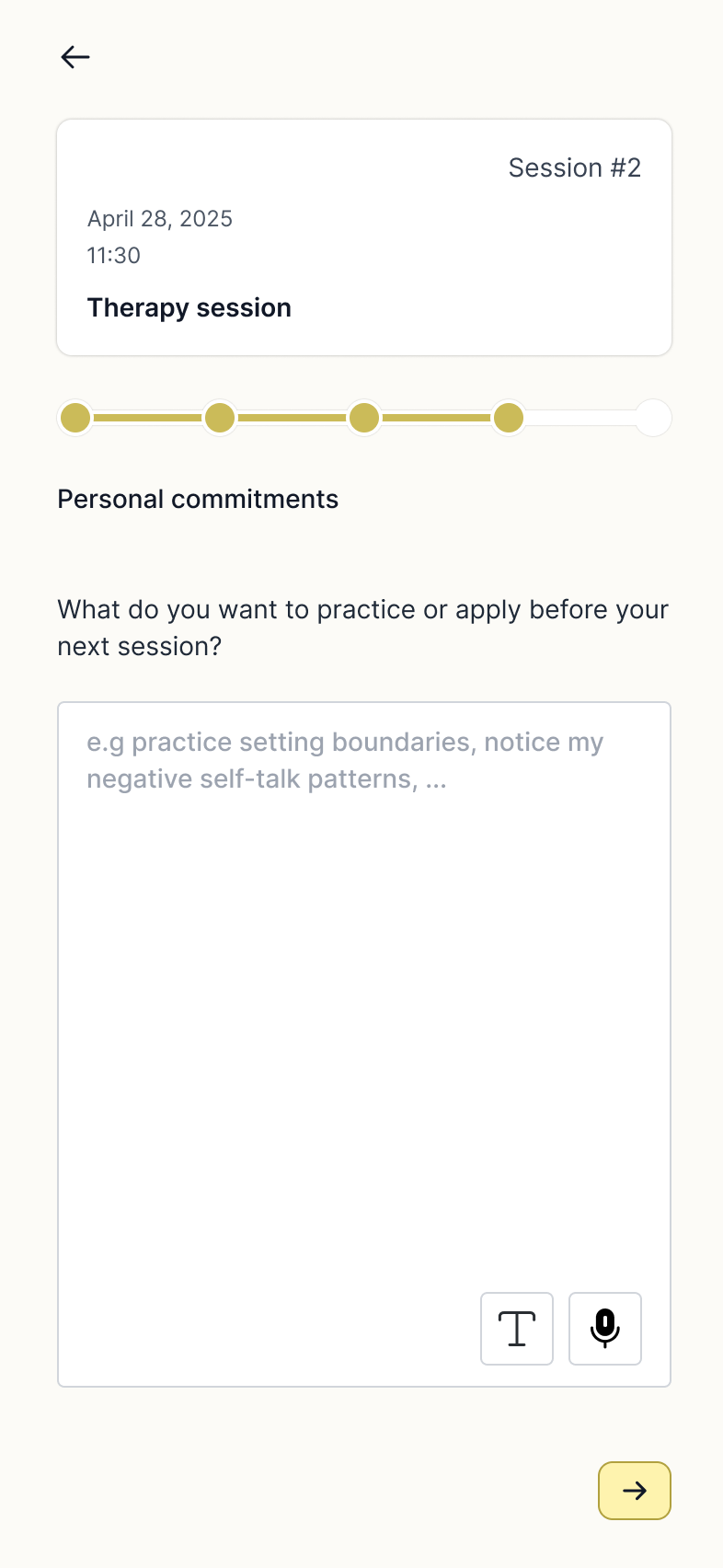
The last two sections are dedicated to users' personal commitments and to the information about the next appointment.

Questionnaire personal commitments Questionnaire next appointment

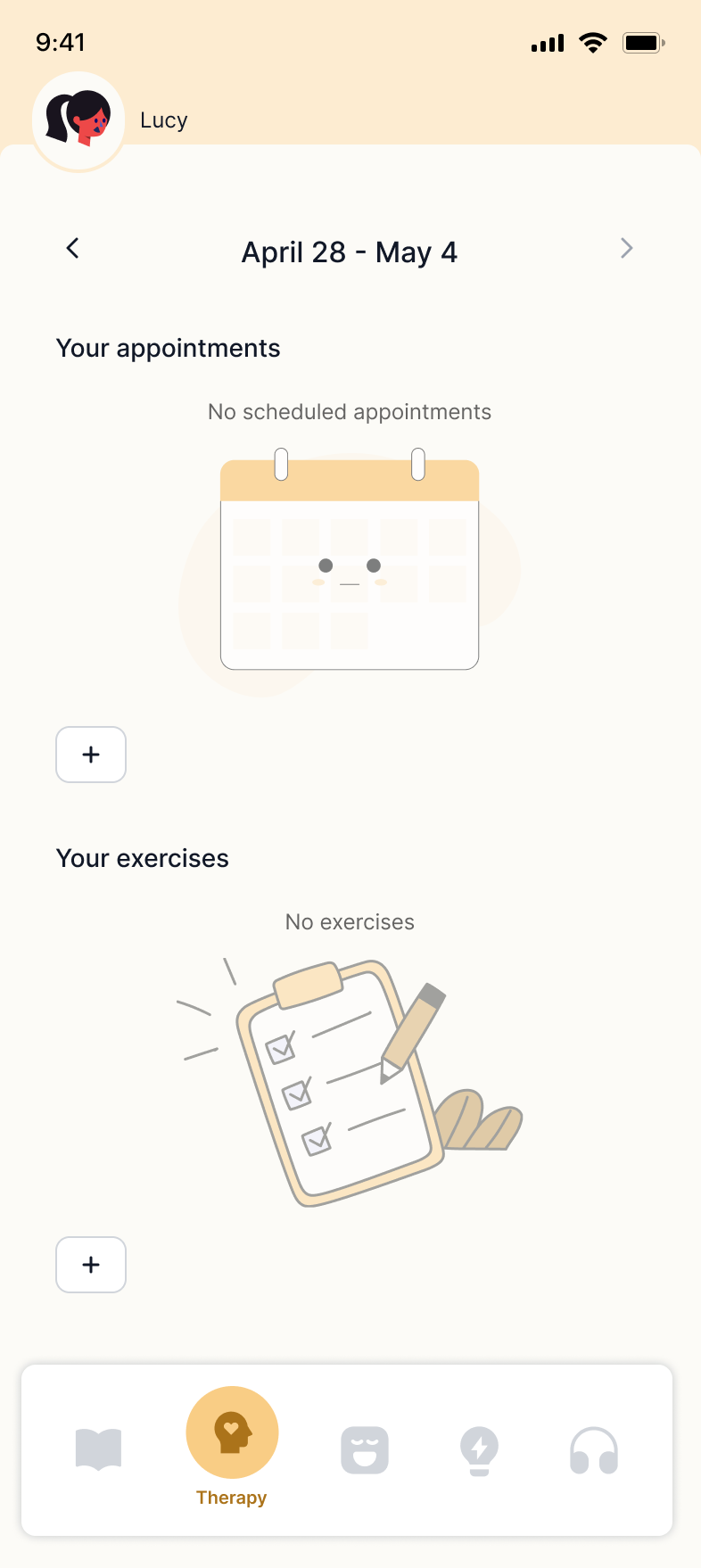
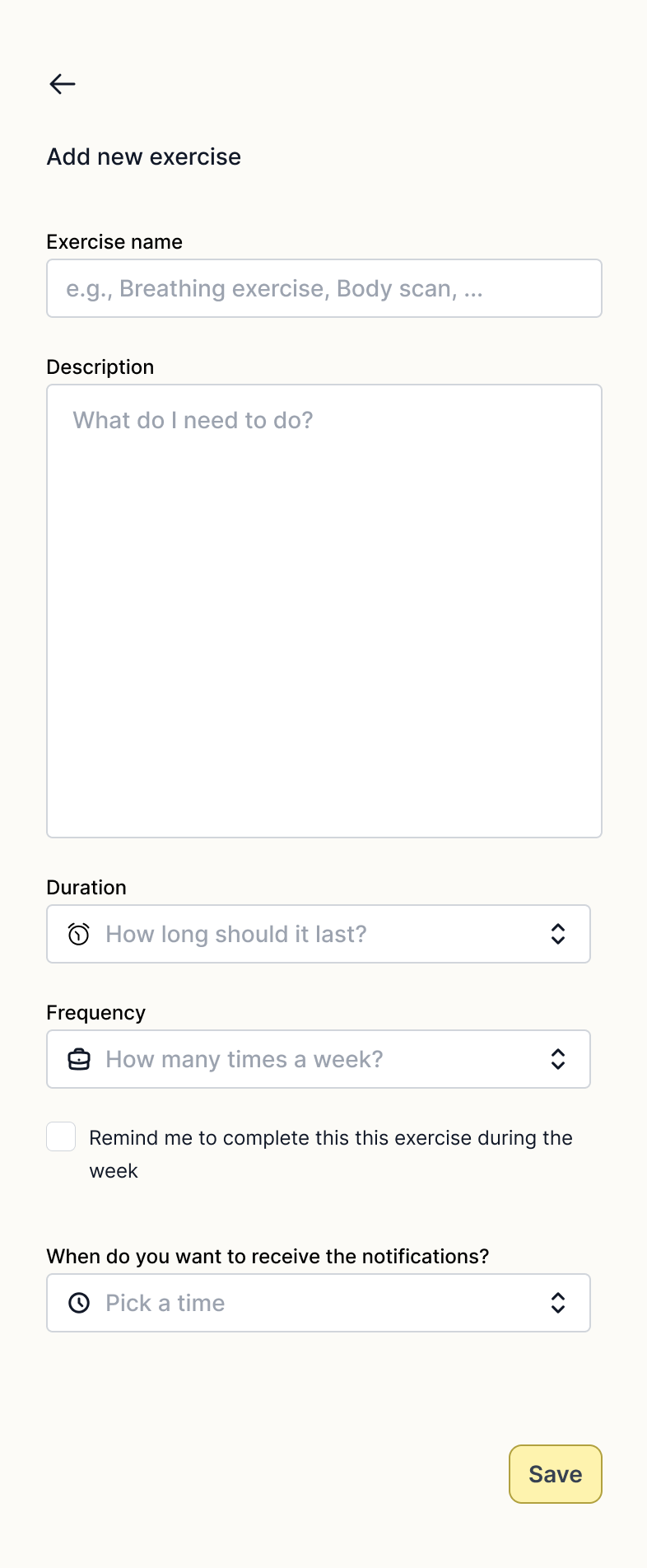
If the section are empty, the user can add appointments and exercises by clicking the plus button.

Empty therapy section Add new exercise screen

Testing

Methods

After developing the first prototype is ready, a first round of testing is necessary before the next design iteration. The goal is to identify any major usability issues or pain points encountered in the two main sections.

Experimental design

  • Participants: at this stage, 5 participants are sufficient to gather major insights and highlight major usability issues. Given the nature of the app and the task, they should be individuals who attend therapy.
  • Testing duration: 1 hour.
  • Instructions: after answering a few demographic questions, participants will be asked to take a first look at the app and describe what they see and what captures their attention. Next, they will complete three tasks: first, write a journal entry (chosen by the tester) and view it in the designated section; then, answer the app questionnaire typically presented after a therapy session, reflecting on their last appointment; finally, add a therapy exercise. Participants should think aloud throughout the tasks. At the end, participants will be asked to rate their experience for the ease of use and app clarity on a 5 point Likert scale.

Measures

  • Task success rate: whether participants complete each task successfully without help.
  • Time on task: how long it takes for participants to complete each task.
  • Error rate and types: keeping track of user errors or misunderstandings during tasks, such as navigation mistakes, or confusion about UI elements.
  • Think-aloud data: analysis of participants' verbal comments for pain points, confusion, and feedback.
  • Ease of use and satisfaction: the ratings given at the end of testing.

Share feedback about Journeal